• ? 56 ? AA ??? PC ?? ????? 5 ??????????? - ???? HKEPC

    From Mr. Man-wai Chang@3:633/10 to All on Wednesday, March 04, 2026 01:17:01
    ? 56 ? AA ??? PC ?? ????? 5 ??????????? - ????
    HKEPC
    <https://www.hkepc.com/25171/>

    How Many AA Batteries Does it Take to Power A PC Setup? - YouTube <https://www.youtube.com/watch?v=U5lskFXDbWs>

    --
    @~@ Simplicity is Beauty! Remain silent! Drink, Blink, Stretch!
    / v \ May the Force and farces be with you! Live long and prosper!!
    /( _ )\ https://sites.google.com/site/changmw/
    ^ ^ https://github.com/changmw/changmw


    --- PyGate Linux v1.5.12
    * Origin: Dragon's Lair, PyGate NNTP<>Fido Gate (3:633/10)
  • From Paul@3:633/10 to All on Tuesday, March 03, 2026 13:15:24
    On Tue, 3/3/2026 12:17 PM, Mr. Man-wai Chang wrote:
    ? 56 ? AA ??? PC ?? ????? 5 ??????????? - ???? HKEPC <https://www.hkepc.com/25171/>

    How Many AA Batteries Does it Take to Power A PC Setup? - YouTube <https://www.youtube.com/watch?v=U5lskFXDbWs>


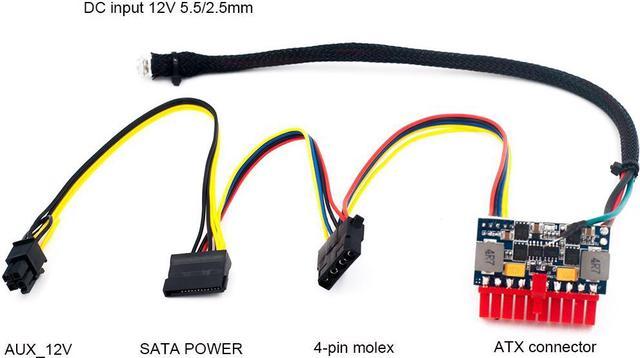
    This style adapter is used for mini-itx lower power systems.

    This runs off +12VDC but does not regulate the +12V feeding
    the motherboard and disk drive. It makes 3.3V and 5V, some -12V
    perhaps.

    The total power draw of that adapter is 12V @ 10A (if the
    motherboard draws that much in total). That means 10 amps
    would be flowing through an Adaptaplug M barrel connector.
    That's a bit too much current for the most popular
    barrel connector type. Even the fatter barrel connector
    is not likely to be rated at 10A, maybe a bit less.
    The machine I'm typing on right now, runs at 36W (I have the
    power meter connected to it). It used to run at 33W when I had
    a small monitor, it runs at 36W driving a 4K monitor.

    https://c1.neweggimages.com/productimage/nb640/AK97_13201846999615423495CeNLx40h.jpg

    You could use the dry cells as (7) sets of 8 cells each (8*1.5V).

    An automotive 12V lead acid battery would be 12.6V fully charged, and
    if it was slightly run down, that would be a better voltage
    value for running a PC. 12.5V feeding the ITX adapter would
    be about as high as I'd want to go (if you were using a
    3.5" hard drive). If there is no 3.5" hard drive, you could
    go a bit higher on the 12V. You would not take the battery
    off its charger, and use it while the terminal voltage on it
    was still 14.4V. You have to wait a day for the battery to
    settle to 12.6V .

    Other battery chemistries are better (lithium), as the cells can
    produce more amperes. With the dry cells, the old ones
    would "swell" at 2 amps load or so (which could be gas
    evolution in the battery jacket). That's one reason you
    have to be careful when playing around with battery power.
    You have to know what the failure mode of the batteries is,
    and what the consequences could be.

    But otherwise, that's a pretty expensive way to power a PC, as
    the batteries aren't going to last all that long.

    He could have demonstrated his design prowess, by running the
    PC off a large solar panel.

    *******

    If you want to see some desperate science at work, the people in this
    area have trouble finding chargers for their BEV cars. So someone
    is building "fast chargers" which are powered from solar cells
    plus a battery bank. The battery bank only has 200kWh in it.
    You can tell from that, how many cars they can fill before the
    "station" is "out of gas" :-) These are fast chargers without
    mains power. This approach is more practical in summer, as the
    solar output in winter is 10x lower. In a couple more years,
    a competing solution will come along that can also charge cars.
    But this will suffice to make "heroic" trips possible on that road.
    Pack a lunch.

    https://www.ctvnews.ca/winnipeg/article/new-charging-stations-open-northern-gateway-for-electric-vehicle-travel/

    Some of the indigenous towns have a solar farm, which aids power
    generation for homes so it does not all come from the
    consumption of diesel fuel and diesel generators. Apparently
    the solar farm is large enough, they can turn off the diesel
    generators from 10AM to 2PM... if it is a cloudless day
    (which is not too likely). That style of solar farm has
    no lithium battery bank. In the news article above, the
    design uses lithium storage so the station can charge
    a BEV later in the day. To build a real charging station
    that way, would take a lot more storage than 200kWh. But
    since the project is unlikely to be subsidized, the dimensions
    of the project must be kept small.

    Paul

    --- PyGate Linux v1.5.12
    * Origin: Dragon's Lair, PyGate NNTP<>Fido Gate (3:633/10)
  • From Mr. Man-wai Chang@3:633/10 to All on Wednesday, March 04, 2026 18:25:25
    On 3/4/2026 2:15 AM, Paul wrote:

    An automotive 12V lead acid battery would be 12.6V fully charged, and
    if it was slightly run down, that would be a better voltage
    ....
    But otherwise, that's a pretty expensive way to power a PC, as
    the batteries aren't going to last all that long.

    He could have demonstrated his design prowess, by running the
    PC off a large solar panel.
    He shuold have forget about a regular PC motherboard, but Raspberry Pi.
    I think Pi 4 could run Windows 8? I dunno. Never tried. :)

    --
    @~@ Simplicity is Beauty! Remain silent! Drink, Blink, Stretch!
    / v \ May the Force and farces be with you! Live long and prosper!!
    /( _ )\ https://sites.google.com/site/changmw/
    ^ ^ https://github.com/changmw/changmw

    --- PyGate Linux v1.5.12
    * Origin: Dragon's Lair, PyGate NNTP<>Fido Gate (3:633/10)
  • From Mr. Man-wai Chang@3:633/10 to All on Wednesday, March 04, 2026 18:47:09
    On 3/4/2026 2:15 AM, Paul wrote:
    But otherwise, that's a pretty expensive way to power a PC, as
    the batteries aren't going to last all that long.

    He could have demonstrated his design prowess, by running the
    PC off a large solar panel.

    BTW, he should have tried some old motherboards. Might be a lot easier, simpler and use less electricity. Modern CPUs are power-hungry.

    --
    @~@ Simplicity is Beauty! Remain silent! Drink, Blink, Stretch!
    / v \ May the Force and farces be with you! Live long and prosper!!
    /( _ )\ https://sites.google.com/site/changmw/
    ^ ^ https://github.com/changmw/changmw

    --- PyGate Linux v1.5.12
    * Origin: Dragon's Lair, PyGate NNTP<>Fido Gate (3:633/10)
  • From Paul@3:633/10 to All on Wednesday, March 04, 2026 18:03:59
    On Wed, 3/4/2026 5:47 AM, Mr. Man-wai Chang wrote:
    On 3/4/2026 2:15 AM, Paul wrote:
    But otherwise, that's a pretty expensive way to power a PC, as
    the batteries aren't going to last all that long.

    He could have demonstrated his design prowess, by running the
    PC off a large solar panel.

    BTW, he should have tried some old motherboards. Might be a lot easier, simpler and use less electricity. Modern CPUs are power-hungry.


    It's the opposite. Modern systems have good idle power ratings.
    Like mine draws 33W at idle, when driving a smaller-than-HD
    resolution screen. And that's a system with a low end NVidia
    card in it as well. The NVidia card was added because of a
    crashing problem when using the iGPU.

    My first PC compatible, drew 150W at idle and 153W when
    the single core CPU was railed. There was no power
    control to speak of. And at 150W, it is unlikely
    the PC could boot before the batteries were flat (or overheated).
    The CPU draws about 35W out of the 150W number (that was
    a 440BX with a Tualatin adapter in it and a Tualatin 1.4GHz
    was the fastest CPU I had for that setup).

    Some of the mini-PC boxes, they have 7W processors, so
    their power consumption is similarly limited.

    If you are talking about running a 14900K in such a project,
    that is unlikely to be a good choice. The CPU can turbo to 6GHz
    on the P cores, and when that happens, those batteries will be
    flat in no time. Similar to my computer on the other side
    of the room, they draw 200+ watts when running 7ZIP compression,
    and that isn't a good choice for a battery project. But if you
    had an N150 processor (4 cores), those have quite low power
    consumption and would last a bit longer.

    Paul

    --- PyGate Linux v1.5.12
    * Origin: Dragon's Lair, PyGate NNTP<>Fido Gate (3:633/10)
  • From Mr. Man-wai Chang@3:633/10 to All on Thursday, March 05, 2026 14:32:13
    On 3/5/2026 7:03 AM, Paul wrote:
    On Wed, 3/4/2026 5:47 AM, Mr. Man-wai Chang wrote:

    It's the opposite. Modern systems have good idle power ratings.
    Like mine draws 33W at idle, when driving a smaller-than-HD
    resolution screen. And that's a system with a low end NVidia
    card in it as well. The NVidia card was added because of a
    crashing problem when using the iGPU.

    My first PC compatible, drew 150W at idle and 153W when
    the single core CPU was railed. There was no power
    ....

    I surely have no data to support my wild guess about power requirement
    of old motherboards and CPUs. :)

    --
    @~@ Simplicity is Beauty! Remain silent! Drink, Blink, Stretch!
    / v \ May the Force and farces be with you! Live long and prosper!!
    /( _ )\ https://sites.google.com/site/changmw/
    ^ ^ https://github.com/changmw/changmw

    --- PyGate Linux v1.5.12
    * Origin: Dragon's Lair, PyGate NNTP<>Fido Gate (3:633/10)
  • From Paul@3:633/10 to All on Thursday, March 05, 2026 12:57:30
    On Thu, 3/5/2026 1:32 AM, Mr. Man-wai Chang wrote:
    On 3/5/2026 7:03 AM, Paul wrote:
    On Wed, 3/4/2026 5:47 AM, Mr. Man-wai Chang wrote:

    It's the opposite. Modern systems have good idle power ratings.
    Like mine draws 33W at idle, when driving a smaller-than-HD
    resolution screen. And that's a system with a low end NVidia
    card in it as well. The NVidia card was added because of a
    crashing problem when using the iGPU.

    My first PC compatible, drew 150W at idle and 153W when
    the single core CPU was railed. There was no power
    ....

    I surely have no data to support my wild guess about power requirement of old motherboards and CPUs. :)


    I only got the power meter, maybe 10 years ago, and to measure
    the 440BX, that was done with a clamp-on AC ammeter.

    The 150W measurement is not very accurate.

    The power meter, uses a chip similar to the one that does
    whole house digital power metering, about 1% accurate or so.
    The measurement is done at the wall plug, the chip integrates
    the area under curves and is capable of determine W and VA.
    It can measure real and reactive power, and work out the
    power factor PF. A power factor of 1.0 exists on ATX supplies
    that have "active power factor correction". What that means
    is, the power drawn is purely resistive (like an incandescent
    bulb), there is no reactive (inductive or capacitive) power drawn.

    For example, when the PC power supply makes +5VSB and the
    computer is not really doing anything at all (this is NOT sleep),
    the power meter measures this as 1W and 7VA. The local power
    billing, charges for the 1 Watt. The 7VA is "reactive power"
    and the power factor of the PSU is poor. The +5VSB portion
    of the power supply, may not be using power factor correction,
    which is why the reactive component (7VA or seven volt amperes)
    is that high.

    If I were to measure the 440BX computer again, I could use
    that power meter, instead of the ammeter I used previously.
    And then I would get a much more accurate measurement. The
    ammeter has poor poor accuracy for this work.

    But the message remains the same, that old computers are
    generally bad citizens when it comes to wasting power.

    The old computer, cannot even drive my 1920x1080 monitor. The
    DACs on the video card, don't go that high. Which means if
    I booted the 440BX into Windows 98, the screen would be
    distorted and circles would be rendered as ellipses.
    And back in the old days, the video card had two output
    connectors, one might do 1152x864 , the other could do
    1024x768 , so if you had dual-monitors, it could not
    even do both of them at 1152. The second output used
    a "cheaper" DAC.

    Paul


    --- PyGate Linux v1.5.12
    * Origin: Dragon's Lair, PyGate NNTP<>Fido Gate (3:633/10)
  • From Mr. Man-wai Chang@3:633/10 to All on Friday, March 06, 2026 18:37:35
    On 3/6/2026 1:57 AM, Paul wrote:

    I only got the power meter, maybe 10 years ago, and to measure
    the 440BX, that was done with a clamp-on AC ammeter.

    The 150W measurement is not very accurate.
    ....
    But the message remains the same, that old computers are
    generally bad citizens when it comes to wasting power.

    I understand.

    Too bad nobody would manufacture Intel 440BX era hardware stuffs using
    modern fab. :)

    It's still an interesting experiement to try powering modern
    motherboards using AA batteries.

    --
    @~@ Simplicity is Beauty! Remain silent! Drink, Blink, Stretch!
    / v \ May the Force and farces be with you! Live long and prosper!!
    /( _ )\ https://sites.google.com/site/changmw/
    ^ ^ https://github.com/changmw/changmw

    --- PyGate Linux v1.5.12
    * Origin: Dragon's Lair, PyGate NNTP<>Fido Gate (3:633/10)